By Steven Dalgetty, Dillon Hooks, and Collin Nelson
By 1920 the automobile had thoroughly become the new, most popular and effective form of travel. The swift expansion of the automobile industry was led by Henry Ford who annually produced brand new models to satisfy the tenacious public demand. Increasing public wages and minimal costs due to mass production made cars extremely affordable even though three out of every four cars bought were on installment plans.
By 1920 the automobile had thoroughly become the new, most popular and effective form of travel. The swift expansion of the automobile industry was led by Henry Ford who annually produced brand new models to satisfy the tenacious public demand. Increasing public wages and minimal costs due to mass production made cars extremely affordable even though three out of every four cars bought were on installment plans.
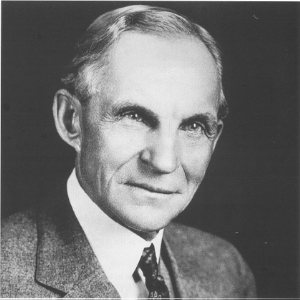 |
| Henry Ford |
Roads that had been designed for horse travel were beginning to dwindle away under the pressure of uprising traffic. In 1906 local governments had participated in 96 percent of road funding. By 1927 local governments only supplied 53 percent of the funding while state and federal government covered the rest. During the time of horse drawn transportation, local administration was responsible for the majority of all road maintenance and construction; but when it became known that the automobile would soon take over, a wider range of jurisdiction was needed to compensate. In order to accommodate the automobile, roads would need to be redesigned and rebuilt, as well as for the federal government to introduce new road laws to control traffic in heavily populated areas.
The automobile had allowed people to travel faster and further than ever before. Tourism had become a popular theme among the populace however motorists would need to plan carefully as gas stations would often be far apart. Motels and other tourist facilities began to pop up all over the country in order to service travelling motorists. Gas stations as well began to take advantage of the uprising by offering food and drink to motorists who passed by to refuel their car.
Most of the early models of the automobile were convertibles (lacking a top hood) but it did not take but a few decades before they were enclosed and fitted with heaters to improve passenger comfort. Many of the older companies that specialized in horse drawn vehicles quickly made a transition to manufacturing automobiles. Many of the fancier cars that were owned by wealthier folks were often custom made and driven by personal chauffeurs.
 |
| Henry Ford's Model T |
As cars began to become more prominent, new methods of advertising were employed by copywriters, using psychology to gain a marketing edge. Originally, ads had promoted horsepower and specifications but in the 1920's they began to lean towards people's emotions. Also, car manufacturers often targeted women with their ads by posting them in women's magazines and making their cars more attractive to women. They accomplished this by offering a wider gamut of colors as well as improving the quality of the upholstery.
Many of the new paint jobs on cars were based on those of English coaches. Never before had cars looked so elegant, coated in a medley of color patterns. Along with new dazzling appearances, the automobile had very quickly became adherent to passenger comfort as of the late 20's. With the addition of balloon tires and better shock absorbers, the car was at its highest demand.
The 1920's had given wealthy upperclassmen an excuse to spend their money on expensive cars. Many of the famous brands were imported from Europe, including cars like the Mercedes and the Hispano- Suiza . America also had their fair share of luxury vehicles such as the Cadillac and the Packard which were often favored by movie stars and other well known celebrities. The cost of such quality cars ranged from 15 to 50 thousand dollars which is equivalent to five times that amount in today's currency.
 |
| Mid 1920's American Cadillac |
The car has left an everlasting legacy on America by revolutionizing transportation. Before the automobile had been introduced, people who had lived in the city, had worked in the city, and in turn those who lived in rural areas, had become farmers. The car had enabled people to work in the city while living on the outskirts, making it much easier to obtain a job while maintaining a desired living style. Even more importantly, the car has introduced numerous job for the world's growing population, including: fast food, gas stations, convenience stores, road construction, highway patrol, car shops, and auto repair shops.
Bibliography
Bellis , Mary. "Automobile History." about.com. NY times company, 2011 . Web. 13 Mar 2011. <http://inventors.about.com/od/cstartinventions/a/Car_History.htm>.
Benz, Carl. "Automobile." ideafinder.com. The Great Idea Finder, 2005. Web. 13 Mar 2011. <http://www.ideafinder.com/history/inventions/automobile.htm>.
